• Welcome to Jetboaters.net!

    We are delighted you have found your way to the best Jet Boaters Forum on the internet! Please consider Signing Up so that you can enjoy all the features and offers on the forum. We have members with boats from all the major manufacturers including Yamaha, Seadoo, Scarab and Chaparral. We don't email you SPAM, and the site is totally non-commercial. So what's to lose? IT IS FREE!

    Membership allows you to ask questions (no matter how mundane), meet up with other jet boaters, see full images (not just thumbnails), browse the member map and qualifies you for members only discounts offered by vendors who run specials for our members only! (It also gets rid of this banner!)

    free hit counter

Twist Lock Cleanout Plug Breakdown - pics and 3D printed replacement for white spring cap

drewkaree

Jetboaters Fleet Admiral 1*
Messages
9,269
Reaction score
34,799
Points
867
Location
Central WI
Boat Make
Yamaha
Year
2019
Boat Model
AR
Boat Length
21
I've already posted this before, but I'm breaking this out on its own to make it hopefully easier to find, and not get lost in the threads for those who search. I'm also doing it to create one place for the included files, for anyone to 3D print replacements for the little white caps that cover the springs for the Twist Lock style cleanout plugs. This was all done after @KingCold had an issue with some missing parts, linked here but thanks to his measurements, this turned out to be the push needed to solve the problem of replacing the white caps that you'll see later on down in this thread. I'm also adding the original files from that thread. Those files simply give options to those who wish to look at the original design, and test them for yourself. I've noted the older file that's attached - I recommend the other one, but I'd like options, so I'm including them for others here too

The zip files attached here have the following files: 3mf, STL, STEP and F3D files

For those of you who have a 3D printer, you should know what those files are, and should be able to use any of those to print new parts in case you lose the white spring caps for this style of plug. If you don't even see those springs, follow along with this thread to see where they're supposed to go, as well as some measurements of the parts that should be there. I have no idea where to get these parts other than Amazon, and you're going to have to do some of the heavy lifting to find those parts yourself. These SHOULD fit every Yamaha that has this style of cleanout plug - they haven't changed the design as of the date of this thread.

For those who want a non-toxic lube for the rubber gaskets on your cleanout plugs, Click here for a link to make your own safe-around-the-kids cleanout plug seal lube.

While you're looking at this whole area, possibly due to trying to track down some water entering the boat (or a whole lot of water in the bilge), it may be making it past the cleanout plug rubber seals. This may be an assembly flaw, or just very loose tolerances of the parts, and the manhole rebuild kits may not be the actual problem you're having, so just in case your actual problem ISN'T the cleanout plugs and seals for them, click this link here for an all-time winner that was sussed out by @TeeNGee to add o-rings to this area. Follow through the thread for more info regarding that discovery.

Anyway, on with the show
 

Attachments

Last edited:
These are all pics of my plug. See how the skirt tapers towards the plug? If yours is flared out, kinked, or otherwise doesn't have that nice shape, it's going to catch on the walls of your cleanout plug tube. This may catch, or you may Hulk Smash it in there, and get it stuck, due to the large friction areas. This is why (my theory) people suggest lubing up the rubber seal. This won't stop the problem, it will simply make it easier and/or more likely for your plug to slip in nicely. There does exist the possibility that lubing the rubber will not solve anything.

Eventually, the rubber seems to need replacing. You're going to be looking for a "Manhole rebuild kit". PAY ATTENTION to the part number. For the twist lock style of plug, I believe these are post-2016, to the best of my knowledge. This means the kit you're looking for will be part number F3F-67609-09-00 That F3F is the most important thing to verify before ordering.

The second pic shows the plug completely disassembled, and the only tool you should need to disassemble this style of plug is a #2 Phillips screwdriver


img_20191028_134944277_hdr-jpg.147026


img_20201016_154638686-jpg.147027
 
Last edited:
Step one is to remove your plugs from the boat. To do this, undo the 4 screws shown in the first pic below. One has already been removed to demonstrate. This will allow you to remove the stretchy tether, and remove the plug entirely from the boat.

You don't have to completely remove the screws just yet, only loosen them enough to remove the tether. You can remove the 4 screws later, in an area where you can lay the parts out. You can EASILY lose a small screw:


img_20201016_153424235_hdr-jpg.147030
 
Last edited:
At your appropriate location to lay out the parts, finish removing the 4 screws, and remove the black handle piece. This will expose the screw that keeps the spring-loaded metal part (shown in this photo) together. All of the parts EXCEPT for the springs and white spring caps that are below this screw and plate should be included in the Yamaha Manhole Rebuild kit.

I've mentioned the springs 3 times now. Foreshadowing. Take note. PAY ATTENTION. After you remove the screw shown in the pic below, the springs won't send things flying with the kinetic energy of a bullet, but they ARE springs. There's no telling what or how they will get lost. The caps can be replaced. You're on your own if you need replacement springs (at least until someone figures out a replacement part or link to them).

The springs and caps CANNOT be ordered from Yamaha, except in the full assembly. Last I checked, it was $163. BE CAREFUL when removing this big center screw. Caps can be 3D printed, springs are guesswork for now.

The second pic shows that there's some thread paste on that center bolt. It's the friction type of stuff, not Loctite, but still, take care removing it that you don't round out the screw. Easy enough to replace that, but why not just take it easy?

img_20201016_153524165-jpg.147031


img_20201016_153653867-jpg.147032
 
Last edited:
Here's what's underneath that metal part. Those two white "nubs" are covering springs, under/inside them, and those are the pieces that may fall out. Again, the attached file in the first post will allow you to 3d print replacements for those white pieces (or have an online printing service or someone else print them for you). The springs...I've got dimensions and pics, do be so kind as to repay the favor if you need to replace these, and share the link, or info of what keywords or description people should use to track down the springs.

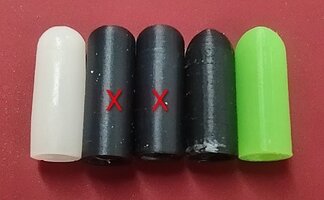
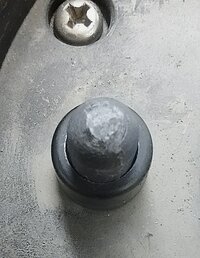
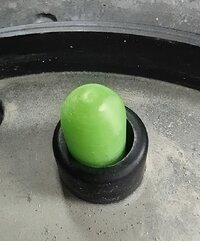
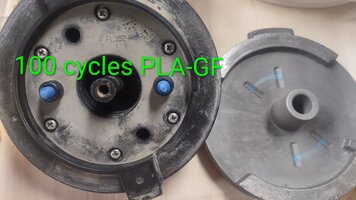
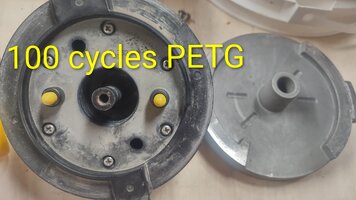
The first pic is of the OEM setup. The other pics show the 3D printed caps I designed and printed. NO, I will not print some for you. The price I will charge you will be obscene, for a reason. This is why I included the files. The blue and black caps are PLA. The blue is HT-PLA-GF. Neither fared well with just a reasonably few cycles of rotation. The green and yellow caps are PETG. With the same amount of cycles (100, twisting from set to lock, and back again), both PETG caps look perfectly fine, minimal wear, and seem to glide better than either PLA version. As for other types of 3D filament, if and when I print them out with other filaments, I'll try to remember to report back. TPU, obviously, is out for a part that needs to slide easily. Other flexible filaments may work, but there's no way I can test all of them. If you want to be a guinea pig and try them, please report back for others.

That pic of the wear on the black plug is NOT just a bad pic, that's the results of bog standard PLA, worn to that point after 100 cycles.


img_20201016_153709983_hdr-jpg.147033


IMG_20260616_021704882_HDR~2(1).jpg


IMG_20260616_020903085~3(1).jpg


IMG_20260616_021031595~2.jpg


IMG_20260616_021207545~2.jpg


IMG_20260618_235627912~2.jpg


IMG_20260619_000122979_HDR~2.jpg
 
Last edited:
Simply pull the white caps off/out. The spring may or may not come with it. Mine didn't, as shown in the pic after this one. For the 3D printed version, the spring will likely stick in the cap, hopefully keeping everything together. It was purposefully designed that way, and does not in any way hinder the spring from performing as it should. The rubber ring maintained its position for mine, yours may simply fall off. I'd say that would be one indicator it needs replacement. Pull the spring along with the white caps.

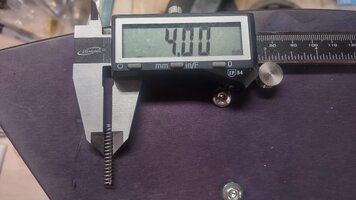
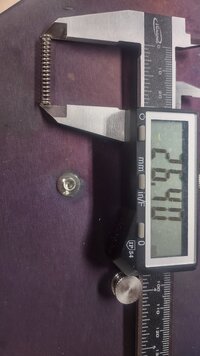
Regarding the spring, I'm also attaching pics of the spring, along with dimensions from my calipers. Again, if you track down replacements, please share.

img_20201016_154001802_hdr-1-jpg.147035


img_20201016_154008674_hdr-jpg.147036


IMG_20260618_235149563_HDR.jpg


IMG_20260618_235005235_HDR.jpg
 
Last edited:
By this point, if your rubber ring hasn't fallen off your plug, pull it off. The pic below shows what you should have.

The rubber ring should only go on one way, but there's no such thing as "foolproof" to a determined fool such as myself, so double check yours against these pics. If yours looks beat up or wonky in some way, look at the rest of the plug, how it's molded, etc If the rubber ring slid off the plug when it was screwed down, it could have gotten pinched, folded, spindled,mutilated...or worse. Buy a rebuild kit and replace it ASAP.

At this point, your cleanout plug is completely disassembled. Assembly with suitable undamaged parts is the reverse.


img_20201016_154041145_hdr-jpg.147037
 
Last edited:
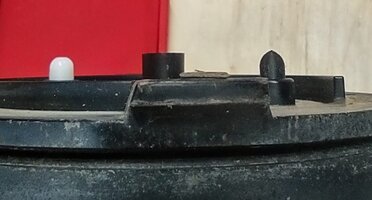
The "ears and tabs", for lack of a better term, need to be in the proper position. Mine move quite easily, which is why I mention the proper position. I have to be careful putting the plugs in IF I hit the side of the holes, because something that slight can (and has) moved those things to the Lock position.

See the tab pointed at the "Set" marking? This position is Unlocked, and you should be able to easily install it.


img_20210417_143453879_hdr-jpg.147154
 
Last edited:
If your plug looks like my plug on the RIGHT, (tab/ear pointing to the right 1-2" from SET marking), then it is in the Lock position, and you will never be able to get it into place. Pay attention and fix that, there ARE stories on here of people discovering that these plugs are a bear to remove if they're improperly installed


img_20210417_151027941_hdr-jpg.147155
 
Last edited:
To close this out, my plugs worked and turned easily for quite a few years without doing ANYTHING to them, like lubing them up. Now, lubing them with some stuff I made (See the link in the first post of this thread) should get me a few more years, but the rubber gaskets really should be considered a wear item, and you should check them at the beginning or end of every season, and replace them when they start to look cracked, spongy or just worn down.

My plugs still turn easily enough that sometimes if it catches in the hole, it will turn to the Lock position. It makes a sound when this happens, but it CAN be missed if you aren't paying close attention or your hearing is bad (I mention this because I can hear it, but my wife cannot without putting her ear closer to the hole)

Here's my old unlubed plug going in for the first time this year - notice the ring tapering towards the bottom part of the plug

img_20210417_143430946_hdr-jpg.147156
 
Last edited:
Regarding the 3D printing of the replacement caps. My best results were using PETG. TPU is not suitable, and @KingCold even mentioned a rubber plug he tried, that seemed to be worse, most likely due to the friction. PLA does not work at this time. It's simply not going to stand up to repeated friction and wear. It MAY work for a while, but I wouldn't want to bet on when it will fail. Nylon would likely be the best material for this, if you can print it.

If you have a 0.2mm nozzle, I'd recommend that, although I was able to produce satisfactory results with a 0.4mm nozzle, printing at 0.1mm layer height. I was never able to get these to print without a brim, and what I found worked best for me was to use a skirt instead of a brim, 3 layers high, 0.6mm away from the model. When finished printing, popping the prints into the freezer for 5-10 minutes produced a "brim" that easily broke away by simply rolling it around the edge, if it didn't already break away when removing it from the build plate.

I suspect adding the Glass Fiber to the filament allowed more rapid deterioration of the PLA, and I get the feeling that Carbon Fiber filaments would react similarly. I've got some PETG-CF on the way for another project, and I'll probably try it out, but it may be a while, if at all, before I test it out, as PETG seems to work quite well in this application.

ABS would be the other possibility, and ASA doesn't seem needed in this application. From experience with other ABS though, I don't think it'll be as good with sliding as the PETG, but if someone prints these out in ABS, please share.
 
Back
Top